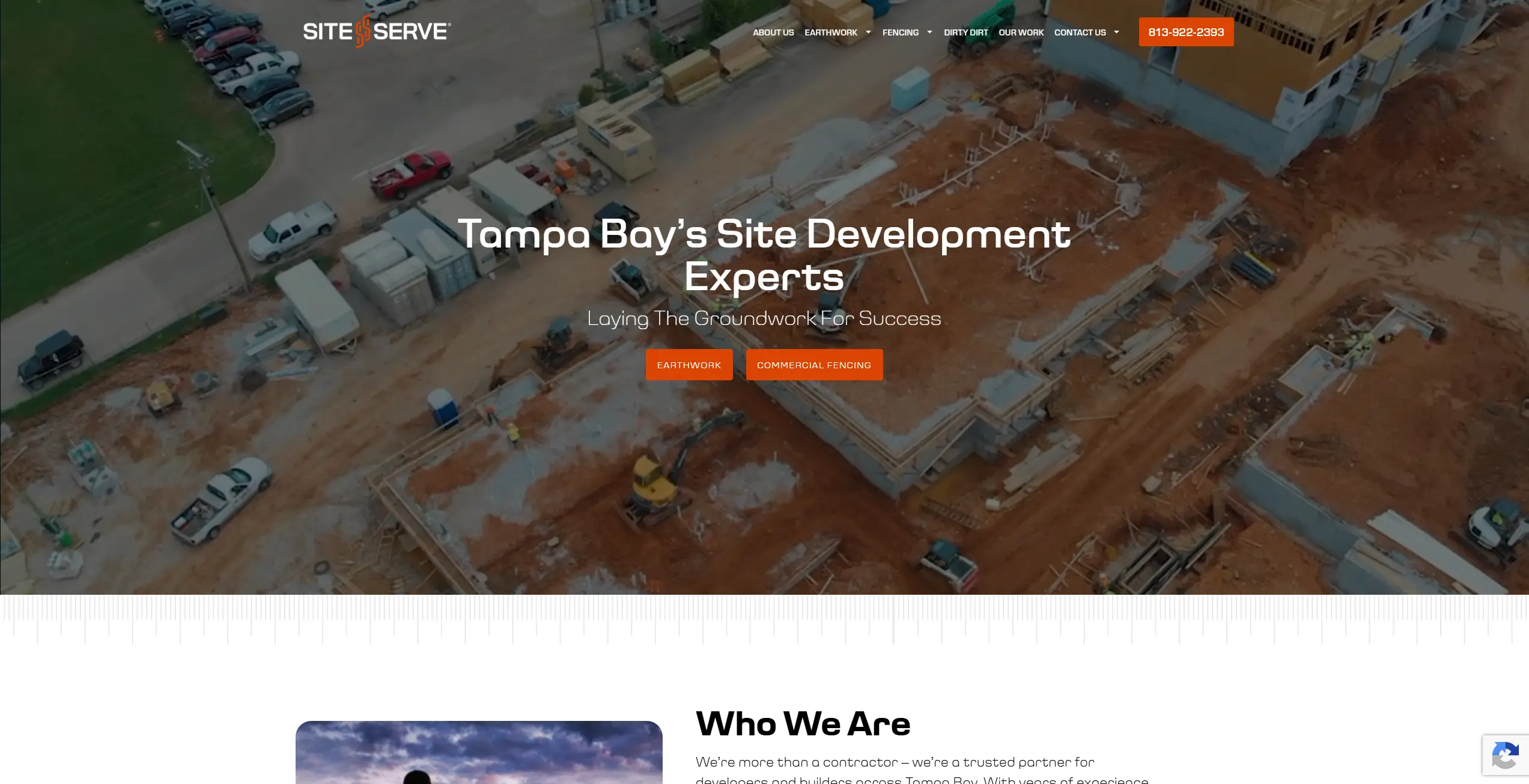
A custom WordPress build that translates a Figma direction into a practical construction-services website. In 2025, I worked on Site Serve USA’s website through HCP Associates Inc., handling the Figma-to-Elementor implementation. The brief was straightforward: make a contractor’s services easy to understand and give prospective clients a clear route to learn more or get in touch.
Client: Site Serve USA
Partner: HCP Associates Inc.
Year: 2025
My role: Custom website build and Figma-to-Elementor implementation
Technology: Figma, WordPress, Elementor
Live website: siteserveusa.com ↗
The challenge: several services, one clear website
Site Serve works across site preparation and perimeter services for contractors and developers in the Tampa Bay region. Visitors may be looking for earthwork, demolition, excavation or fencing, and they need to find the relevant service without navigating an unnecessarily complex website.
The website also has to communicate trust. A construction partner is evaluated on experience, professionalism and the ability to handle real projects. That gives the site three practical jobs: explain the offering, demonstrate work, and make enquiries straightforward.
What I built
1. Figma-based custom frontend
I implemented the website in WordPress and Elementor, translating the supplied Figma design direction into actual page layouts. The focus was a cohesive custom build rather than assembling unrelated pre-made sections. Typography, spacing, imagery and section structure needed to work together across the site.
2. Clear service navigation and content
The website gives distinct space to core activities, including earthwork and site preparation, demolition, excavation and fencing. The information is organized so a visitor can move from a service overview to more detailed explanations and the appropriate contact path.
3. Project evidence and contact routes
Project examples and company information support the service descriptions. Enquiry options are placed in context, helping a prospective contractor or developer take the next step after reviewing the services.
4. Responsive Elementor implementation
The custom layouts were built for use across desktop and smaller screens. The implementation keeps navigation, service descriptions and contact actions usable as the viewport changes.
Outcome and scope
The resulting website provides a structured public presentation of Site Serve’s capabilities, visible project work and contact options. My documented contribution was the website implementation with Figma and Elementor, working in partnership with HCP Associates Inc.
This was a focused website build. I am not presenting HCP’s wider brand, marketing, research or SEO work as my own, and I am not claiming traffic or lead-generation results without verified measurements.